Why Shark Heads Change

Amit Sharma
| 14-09-2026
 · Animal Team
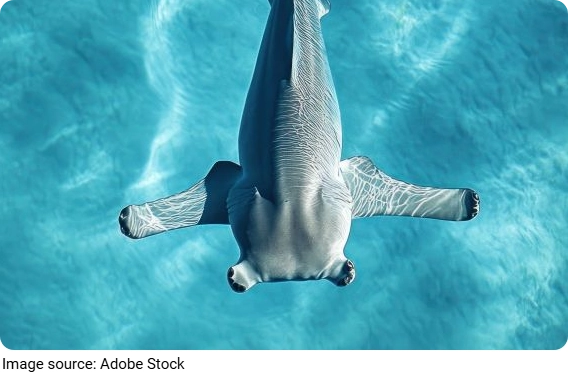
Scientists have discovered that bonnethead sharks develop their distinctive heads differently from what researchers previously believed. Both males and females begin life with relatively pointed heads, but the shape becomes rounder as they mature, particularly in females.
The finding overturns the idea that males develop their sharper snouts only after reaching reproductive maturity.
A Long-Held Theory Falls Apart
Bonnetheads (Sphyrna tiburo) are small members of the hammerhead shark family, recognised by their broad, shovel-shaped heads. They are unusual among sharks because mature males and females have noticeably different head profiles.
Males generally retain a more pronounced point along the front edge of the head, while females develop a smoother, more rounded outline. This visible difference between males and females has puzzled researchers for years.
Earlier research suggested that the pointed shape emerged in males as they reached reproductive maturity. The new study, led by researchers at the University of Miami Rosenstiel School of Marine, Atmospheric, and Earth Science, found a different pattern. Young males and females both have relatively pointed heads, while ageing leads to increased rounding in both groups. The transformation is much stronger in females, creating the distinctive contrast seen later in life.
Researchers Examined 144 Sharks
To investigate how head shape changes over time, the team studied bonnetheads from two populations on opposite sides of Florida.
Between May 2022 and May 2023, researchers examined 105 sharks from Biscayne Bay and another 39 from the Tampa Bay region. The comparison allowed them to see whether similar developmental patterns appeared under different environmental conditions.
Each shark was measured and photographed from both sides of the head against a specially designed grid. Researchers then used ImageJ software to analyse head curvature and compare differences related to body size, age and maturity. Small muscle samples were also collected before the animals were released.
The method provided detailed measurements while keeping handling time as short as possible.
Diet Does Not Explain The Difference
The researchers also investigated whether feeding behaviour could explain why males and females develop different head shapes.
Muscle tissue from 137 sharks was analysed for carbon and nitrogen isotopes. These chemical signatures can reveal information about an animal’s feeding environment and its position within a food web over a longer period than stomach-content analysis alone.
The results revealed clear differences between sharks from Biscayne Bay and Tampa Bay. Their isotope signatures showed little overlap, indicating that the populations were feeding within ecosystems with distinct environmental characteristics.
However, males and females living within the same bay relied on many of the same local food sources. The researchers therefore found no evidence that different diets or feeding strategies were responsible for the contrasting head shapes.
Different isotope signatures between the two regions also do not necessarily mean the sharks were eating completely different prey. Similar species can carry different chemical markers depending on the ecosystem in which they live.
The Evolutionary Mystery Remains
The study answers one question about bonnethead development but leaves another unresolved: why is a pointed head useful in the first place?
One possibility is that the shape helps younger, smaller sharks move through the water more efficiently. Females eventually grow larger than males, partly because of the physical demands of reproduction, so the potential advantages of a sharper profile may become less important as they mature.
This explanation remains a hypothesis. Future studies examining swimming efficiency and early development could help determine when the differences between males and females first appear and whether hydrodynamics plays a meaningful role.
The research focused on populations in Florida, so bonnetheads elsewhere may show different patterns. Studying sharks across a broader geographic range could reveal whether local environmental conditions influence head development and whether distinct populations require different conservation approaches.
For now, the bonnethead remains an evolutionary puzzle. Scientists no longer need to explain why mature males suddenly develop pointed heads; instead, they must understand why both males and females begin with them and why females lose much more of that shape as they grow.