Exploring the Zeptoverse

Mukesh Kumar
| 24-11-2026
 · Astronomy Team
Some of the most important questions in physics may require scientists to study things far smaller than an atom. At CERN's Large Hadron Collider (LHC), researchers have now reached an important milestone after finding evidence of a particle transformation that has remained difficult to observe for more than four decades.
The finding comes from the upgraded LHCb experiment and concerns a process expected to happen only once in approximately 10 billion beauty particles. Although the result is not yet strong enough to count as a confirmed discovery, it gives researchers a valuable new way to test existing ideas about how matter behaves.

A Rare Process Finally Shows Evidence
The research focuses on a particle transformation known as Bd to mu mu. It involves a short-lived particle containing a beauty quark, which eventually produces two particles called muons. Muons are similar to electrons but considerably heavier. Beauty quarks belong to a family of fundamental particles and are heavier relatives of the quarks that make up ordinary matter.
Scientists study the different ways these particles decay because each process can provide information about the fundamental rules of nature. Particularly rare transformations are useful because their expected frequency is very precisely predicted by current physics theories. If measurements differ from those predictions, it could indicate that previously unknown particles are influencing the process.
The Bd to mu mu transformation has been especially difficult to measure. Its predicted frequency is so low that researchers need enormous amounts of experimental data and highly sensitive instruments to identify a convincing signal.
Why the New Measurement Matters
The LHCb collaboration reported a statistical significance of 3.2 sigma for the result. In particle physics, this level is generally considered evidence that a signal is present, but it does not meet the stronger standard required to announce a discovery. Scientists typically require five sigma before describing a result as a confirmed discovery. Reaching that level helps reduce the possibility that an apparent signal is simply a statistical fluctuation.
For now, the measurement agrees with predictions from the Standard Model, the leading framework used to describe known fundamental particles and their interactions. This means researchers have not yet identified evidence of a new particle or an unknown physical process.
Nevertheless, the result is important because it demonstrates that scientists can now study a transformation that has resisted observation for more than 40 years. More precise measurements could eventually reveal whether the process behaves exactly as expected or contains subtle differences that current theories cannot explain.
Upgraded Equipment Made the Search Possible
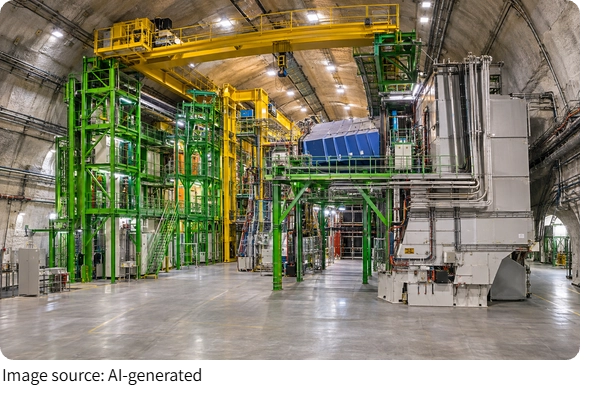
The improved capabilities of the LHCb experiment played a major role in reaching this result. Following a substantial upgrade, the experiment can collect information at up to five times its previous rate. A key component is the Vertex Locator, a silicon pixel detector developed with significant contributions from researchers in the United Kingdom. Positioned just five millimetres from the LHC beams, it records particle paths with exceptional precision.
This technology allows scientists to identify where particles are produced and where they later decay. Such detailed tracking is essential when studying extremely short-lived particles and separating meaningful signals from other activity recorded during collisions. Researchers also benefit from improved methods of identifying different particles and filtering unwanted background signals.
What Scientists Mean by the Zeptoverse
The term Zeptoverse describes a physical scale associated with distances around a zeptometre, approximately a billionth of a trillionth of a metre. At such tiny dimensions, scientists hope to investigate whether particles and interactions exist beyond those currently described by established theories.
The LHC cannot directly photograph or observe objects at every distance involved in this research. Instead, physicists study the behaviour of particles produced in collisions and use their measurements to infer what may be happening at much smaller scales. Rare particle transformations provide a particularly useful method.
The Next Stage of Research
The upgraded LHCb experiment is expected to continue gathering much larger amounts of data into the early 2030s. With more observations, researchers hope to measure the rare transformation with greater precision and determine whether its behaviour consistently matches theoretical predictions.
The latest LHCb result represents progress in a search that has lasted more than four decades. For now, the achievement shows how improvements in experimental technology can reveal details that were once too difficult to measure, bringing physicists closer to understanding the smallest scales of the natural world.

